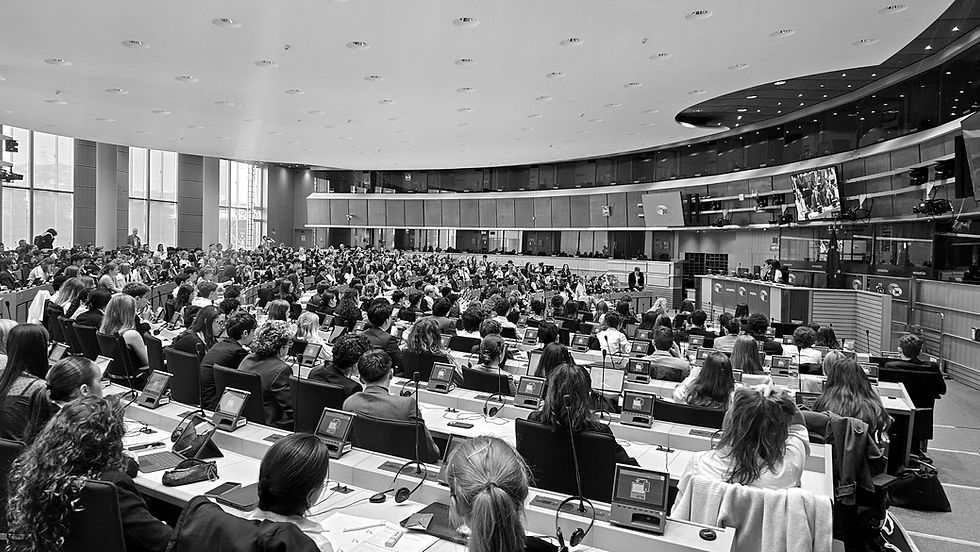
From Brussels to the World: Democratic Innovation Across Borders
Democratic innovation
In 2007, the United Nations proclaimed 15 September the International Day of Democracy. Next year, as that declaration turns 20, Brussels will become European Capital of Democracy. To mark the occasion, What about Dem co-hosted an evening with the City of Brussels and UNDP, bringing together city officials and UN representatives, parliamentarians and academics, youth organisers and civil society leaders.
A city as a democratic laboratory
Frederik Ceulemans set the tone with a touch of irony, presenting Brussels as the capital of the free, democratic world "until Washington reclaims its title". Behind the joke lay a serious idea: the city, already the world's second most international capital, can serve as a laboratory. If it works in Brussels, it can work anywhere.
A shared starting point
The speakers began from an uncomfortable observation. Representative democracy, as it is practised today, is struggling to keep pace with citizens' expectations of a real voice in the decisions that shape their lives. Faced with democratic decline across the world, the room shared one purpose: rebuilding and innovating democratic structures.
A launchpad for 2027
The evening also looked ahead. It offered a first glimpse of Brussels' year as European Capital of Democracy 2027 and introduced a new idea: a Global Academy on Deliberative Democracy. Its aim would be to connect practitioners across the Global North and South and to help local communities develop participatory processes adapted to their own context.
Two panel discussions, moderated by Adelaide Charlie, co-director of the G1000, structured the programme. They moved from broad questions about changing democratic expectations to the sharper tension between representation and participation. The youth voices closed the discussion with a clear request: "use us" for the future of democracy.
Making people feel heard
One theme ran through the evening: the link between citizens and decision-makers. As Camilla Brückner, Director of UN/UNDP Brussels, put it: "Trust triples when the people feel heard." Making people feel heard will therefore be at the heart of the projects planned around Brussels 2027. And one of the most direct ways to do so is to involve citizens in decision-making through a more deliberative model.
Why this matters to What about Dem
For What about Dem, this evening reflects what the organisation works towards every day: bringing citizens, institutions and civil society into the same room, so that democratic innovation becomes a lasting practice rather than a good idea. Renewing democracy is not only a matter of critique. It means building concrete tools, such as citizens' assemblies and other deliberative processes, that give people a meaningful voice in the decisions that shape their lives. Co-hosting this conversation with the City of Brussels and UNDP was a way of putting that conviction into practice.
When Brussels steps into its role next year, it looks set to ride the deliberative wave.