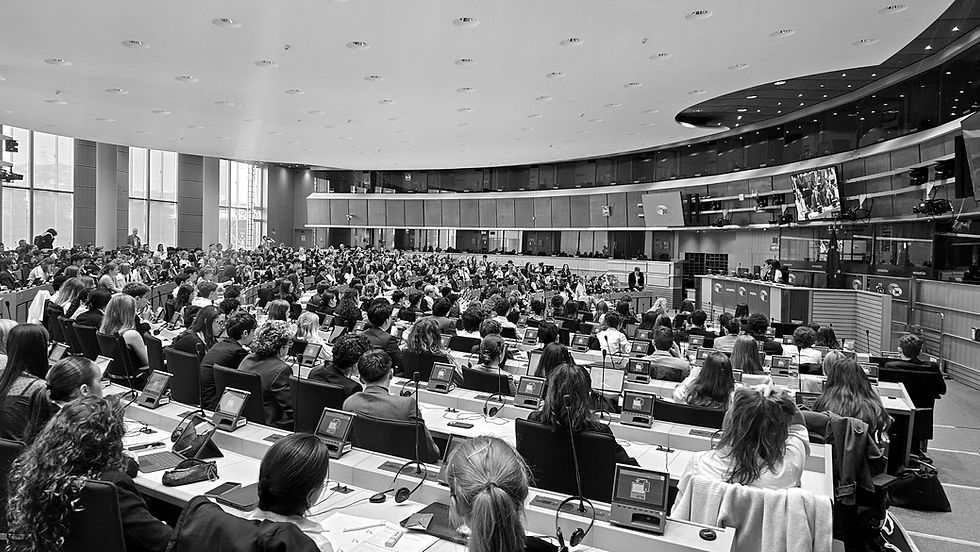
Inside Brussels’ 7th deliberative committee: Three sessions in

Democratic innovation
Three sessions down. Two to go. Brussels’ 7th deliberative committee, the first ever to tackle the issue of cleanliness and waste management in the capital, is now well into its process. After an information session and two full days of discussion, the picture is becoming clearer: not just on the substance, but on what it actually looks and feels like when citizens and parliamentarians sit down together to build something.
Here is what has been happening inside the rooms.
From information to deliberation
The process is structured in distinct phases, each with its own logic.
The initial session focused on information-sharing. Rather than jumping straight into opinions, participants spent a full day building a common foundation of knowledge.
Experts, institutional actors, researchers, and field practitioners presented their perspectives across five main themes: prevention and awareness, inter-institutional cooperation, economic activity, urban planning, and enforcement. The goal was not yet to form positions, but to understand the complexity of the issue, and ask questions
And the questions came. Throughout the day, participants directly engaged with speakers, challenged assumptions, and pushed for clarity on topics ranging from budget allocation between actors to the use of AI-powered monitoring tools.
Two days of deliberation: building toward 2050
The deliberation phase unfolded over a weekend, following a three-part structure: assessing the present, imagining the future, and charting a path between the two.
Participants began by mapping out Brussels as it is today, drawing on their own lived experience as residents. The exercise painted a complex picture: perceptions of uneven cleanliness across neighborhoods, frustration with waste collection schedules, worries about illegal dumping, a sense of fragmented responsibility between too many institutional actors.
Then came the invitation to imagine. Participants were encouraged to close their eyes, breathe, and picture Brussels in 2050. What would it look like? What would have changed? The guidance was simple: quantity matters, draw if you want, and don’t censor yourself. Working in small groups, mixing French and Dutch speakers, citizens and parliamentarians, they produced a wide range of ideas: greener public spaces, underground waste containers, etc…
The final step was the most challenging: how do you actually get from here to there? Each pair of participants took on a specific theme and started sketching concrete pathways. These working sessions fed into group proposals, which were then discussed, voted on, and refined in plenary.
What stands out from inside the room
A few things are worth noting beyond the content of the discussions:
Citizens take their role seriously. Throughout all three sessions, the level of engagement has been consistently high. Participants ask substantive questions and invest in the group work. There were even moments where people were eager to share their ideas before designated time had officially begun. That kind of energy is not a given in participatory processes, it has to be cultivated.
Parliamentians play along. The presence of elected representatives in the same working groups as citizens could easily create an imbalance. Yet, when one participant wanted to defer to a colleague for a task, the group gently negotiated otherwise. These small moments matter.
Diversity is both an asset and a challenge. The group reflects something of Brussels itself: multiple languages, multiple backgrounds, multiple levels of familiarity with institutional processes. Linguistic support is provided throughout buddies during the small group or translators during the plenary. While this inclusive approach can sometimes make the process complex, it also makes it more legitimate.
Facilitators hold it together. Their role is subtle but essential. They set the frame at the start of each session: openness, mutual listening, curiosity. During working time, they move between groups, and ensure no one feels excluded. They also design the exercises, like using post-its, rotating groups, or anonymous dot-voting to prioritize proposals, all aimed at encouraging both broad thinking and deeper exploration. Getting that balance right, session after session, is harder than it looks.
An honest reflection on the limits
Participants themselves have been quite open about what has felt missing. The information session moved fast across five thematic clusters, some felt it was too superficial, that there wasn’t enough time to go deeper on any topic. Others pointed to a lack of quantitative data to ground the discussion. They also expressed a desire to hear more directly from frontline workers and small business owners rather than primarily institutional actors.
One particularly telling observation came at the end of the deliberation days: several participants felt that expert input should have come after the group discussions, not before, so as not to anchor the conversation prematurely. It is the kind of critical reflection that suggests people are not just participating in the process, but thinking critically about it.
What comes next
Two sessions remain. On May 30th, participants will formalize their recommendations, the concrete proposals that will be transmitted. On June 6th, the final report will be presented.
These last two sessions are, in many ways, the most consequential. The quality of what has been built over the past three sessions will be tested by whether it can crystallize into actionable, specific, and politically usable recommendations.
We will be there.
What about Dem is covering Brussels’ 7th deliberative committee from start to finish. Find all our publications in the Deliberative Committees in Brussels section of our website.