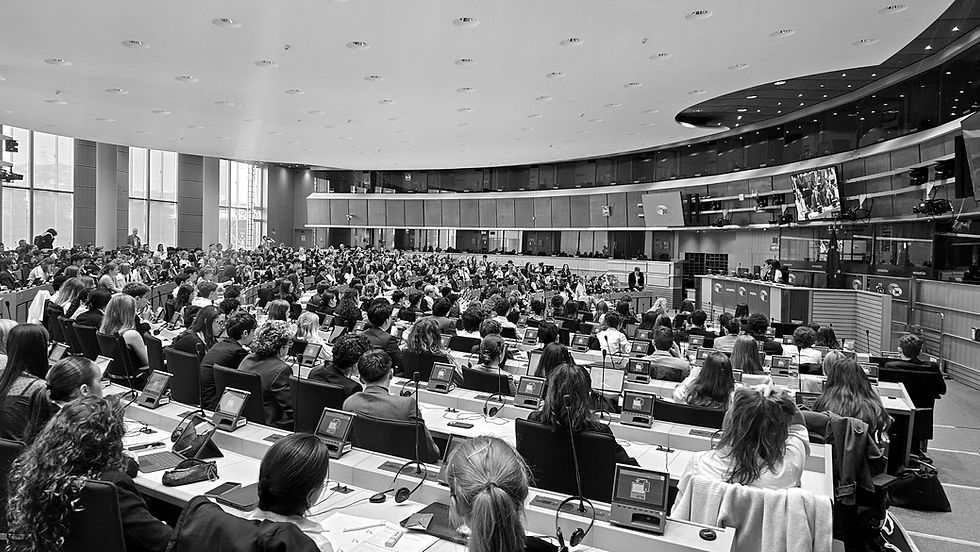
Inside Brussels' 7th deliberative committee: the final two sessions

Democratic innovation
Six sessions. That’s how long it took to complete Brussels’ 7th Deliberative Commission, which focused on cleanliness and waste management in the capital. Following the information and deliberation sessions covered in our previous article, here is an account of the final two stages: the vote on the recommendations, followed by their official submission. The moment when collective work meets institutional reality.
Session 5: when the text takes shape
The fifth session, held on May 30, had a different feel from the previous ones. It was no longer a matter of generating ideas or refining them in small groups, but of voting on texts. Recommendations had been drafted and structured around five themes: governance, awareness & prevention, enforcement & penalties, planning & infrastructure, and organization of waste collection & sanitation professions.
Reading together, improving without distorting
Before reaching the vote, participants moved through the recommendations by rotating between rooms, armed with post-its to suggest clarifications or adjustments to wording. The rule was clear: improve without changing the meaning. Discussions arose, about signage on public bins (QR codes deemed not inclusive enough, eventually replaced by pictograms), about the wording on dedicated waste storage spaces (misread as "instead of" bike rooms, when the intention was "modelled on" them), about free public toilets…
This collective editing process produced sharper, better-shared texts, and ones that those voting on them had actually helped shape.
The vote: broad support, some friction
The voting mechanism is integral to the deliberative framework. Citizens vote first: a deliberate choice that is not insignificant. Since the Belgian Constitution does not allow for citizen co-decision-making, the citizen vote has only consultative value. However, it creates real political pressure on parliamentarians, who then vote publicly and decisively. This sequence is not a formality: it embodies the productive tension between citizen aspirations and representative responsibility.
The plenary vote was, in many ways, the most emotionally charged moment of the entire process. The vast majority of recommendations were approved by large majorities, sometimes unanimously among parliamentarians, with very few votes against on the citizen side. The collective work of the previous sessions was clearly legible in those results.
But the session was not without tension. On certain recommendations, amendments tabled mid-session unsettled some participants. This marks a dangerous step backward, especially since the previous legislature had found a workaround to limit this parliamentary right by adding an extra session, ensuring that amendments would become collectively deliberated observations. One person pointed out that changing a single word ten minutes before a vote can change the entire meaning of a text. Another, who had arrived "with all the joy in the world", said she felt deeply disappointed at not being truly heard. Several people applauded. These moments of discomfort are, in their own way, valuable: they speak to the expectations the process had created, and to the responsibility that is placed on parliamentarians.
Session 6: submitting, closing, and saying goodbye
The final session, on 6 June, was the official submission of the report. A final vote (consultative and secret for citizens, binding and public for parliamentarians) formally adopted the recommendations. The result was strongly positive on both sides.
Accounting for what had been done
The session opened with a restitution of the entire process, presented in turn by citizens and parliamentarians. One citizen summed up the experience in his own way: "I had to run between rooms," a humorous way of saying the pace had sometimes been brisk. Another participant took a more methodical approach, listing the stages, the groups, the debates, and noting that it had all made it possible to "get as close as possible to where we wanted to go."
On the parliamentary side, one member directly acknowledged the frustration that had been voiced during the previous session's vote, a way of hearing without necessarily conceding. Another focused his remarks on the figures and the recommendations themselves, noting that listening had taken place, even if it had not always been visible.
The voices that linger
The closing reflections were the most human moment of the day. Participants took turns sharing, each in their own way, what they were taking with them.
A young participant said she was grateful to have been able to speak and to have been heard by the "adults." Another put into words what many seemed to feel: "In theory I was useful. But in practice, will any of this actually matter?" One participant described the experience as enriching and said he was proud to have taken part, but disappointed by the "political theatre" he had witnessed at moments. Others simply expressed gratitude, pride, or admitted they had not understood at the start what they were signing up for, and that it had turned out to be a good surprise.
The parliamentarians, for their part, paid tribute to the citizens’ commitment. Angelina Chan spoke of a “mini-Brussels” experience from the inside: FR and NL, men and women, different backgrounds, different opinions. “You have provided the vision; it is up to us to realize it, and our role is also to provide guidance with this budgetary vigilance.” For Céline Vainsel, we must now “radicalize the democratic model,” consolidate this type of exercise, review certain operating rules, and give more weight to citizens’ voices. The Secretary of State in attendance, Audrey Henry, took the floor to acknowledge the participants’ commitment.
What stays with us
A process held together until the end. Six sessions, The ongoing involvement of participants, texts produced collectively and voted on. That is no small thing.
The vote is a stage in its own right. It is where citizen output enters into contact with institutional reality, with its own logics and constraints. How that transition is handled (explaining the rules, preserving the legibility of decisions, managing disagreements carefully) is decisive for whether the experience remains legitimate in the eyes of those who took part. Furthermore, this pivotal moment calls for a fundamental reflection on the possibility of genuinely opening the door to co-decision, by agreeing to move beyond a conservative reading of the Constitution to breathe new life into our institutions.
The question of follow-up has been asked. It was raised by several citizens, and it deserves a serious response. A deliberative process does not end with the submission of the report; the follow-up on recommendations is its logical continuation. To guarantee the credibility of this approach, it is essential to scrupulously respect the guidelines vade-mecum of the deliberative committees, thereby avoiding sacrificing the integrity of this initiative from the previous majority on the altar of harmful politicization.
The bond between citizens and parliamentarians is forged through shared challenges. What unfolded in this commission was also a relationship. Not just a process. The parliamentarians were not observers: they were full participants, exposed to the same texts, the same debates, and the same demands for justification. When frustration erupted during the vote, it was because this relationship had created mutual expectations. It is a productive tension, provided we recognize it as such, rather than downplaying it.
A new generation of lawmakers to be trained in the method. The renewal of parliament following the 2024 elections brought in lawmakers, some of whom were discovering how deliberative committees functioned by experiencing it firsthand. This is precisely where the added value of the hybrid approach lies: by bringing together randomly selected citizens and elected representatives within the same framework, it forces participants to clarify the rules, justify procedural choices, and make visible what often remains implicit in ordinary parliamentary work. For elected officials as well as citizens, it is a learning experience. Yet the conditions for this must still be created.
The committee chair must embody the method. This is not a mere matter of protocol. In a deliberative committee, the chair has an educational role as much as a role in steering the debates: explaining the steps, reminding participants of the logic of the process, and creating the conditions for shared understanding. When these steps are not clarified, all participants, citizens and parliamentarians alike—are penalized. The quality of the chair’s facilitation is not merely a nice-to-have: it is a prerequisite for the process’s legitimacy.
What about Dem covered Brussels' 7th deliberative committee from start to finish. Find all our publications in the Deliberative Committees in Brussels section of our website.